
On dead parrots
I think, therefore I invest

John Cleese and I share two important attributes, we both publish on Substack and have endured terrible divorces – I’m glad mine was not $20 million.
I am a long-time fan of Monty Python’s Flying Circus, a TV series from the early 70s that cleverly explored the meaningless aspect of everyday life. The humor stems from mocking the quirks of rigid British stereotypes who attempt to bring structure and justify the existence of nonsensical norms.
Monty Python is a voice for the non-conformist and satisfies our natural desire to challenge and question the existing norms and values in society. However, instead of revolt, the comedy is grounded on intellectual arguments that offers an alternative viewpoint to the mainstream. It indirectly forces the audience to think.

This brings us back to the slap on the face from the previous post that you need to start thinking for yourself. In the famous dead parrot sketch the shopkeeper insists that it is "just resting", "stunned" or "pining for the fjords." For those who pay closer attention you may even be left wondering about Norwegian Blue parrots (spoiler alert, there are no parrots in Norway).
When you read and watch financial news there are plenty of people selling you a dead parrot. If you blindly follow them, you will lose a ton of money.
Do you want proof of people selling you dead parrots? Look no further than the most prolific source of investment memes: Jim Cramer.
Bear Stearns is fine. (video here)
Buy Silicon Valley Bank. (video here)
The metaverse will change everything, buy Meta. The best part is at 2:15 is when David Faber says: “You look ridiculous".
Remember my dear private investor, the reason that you don’t pay commission and you get free trading is because the product is YOU. Wall Street needs someone to hold the bag in the end. Before the 2008 crisis there was an easy way to avoid dead parrots - read Merrill's stock recommendations.
Famous investor Jim Rogers would joke that when Merrill Lynch recommended a stock to its customers it was time to sell. Merrill had a huge network of private investors and that would generate enough volume to absorb the big guys selling.
Don’t buy a stock because someone gave you a tip. There is a famous saying in Wall Street: Tips are for waiters. Nobody would waste their time telling you a great stock recommendation, if they knew it would go up.
So how do you avoid dead parrot companies? Well, there are several ways to identify them when you do the work. Let me share with you one way to spot the dead birds. In this case the company name could not be more appropriate.
Here is an important lesson to any aspiring investor. It has become popular for companies to pretend to promote a social agenda – young people like that. Anyone under 35 grew up in an abnormal peacetime epoch of end of the Cold War, globalization, European Union and we are all friends.
But the world works in cycles, and we are witnessing those trends reverse. Therefore, when you see claim from a company that it is a certified B Corporation be skeptical. It is mostly made-up marketing bullshit (that’s what the B stands for) designed to lower their CAC or improve their margins selling a commodity product. To grow a company is already hard enough, there is no need to create self-imposed obstacles.
Allbirds was once valued at $3.5 billion, and its key differentiation was “Sustainability”. But guess why Nike or Adidas couldn’t match Allbirds sustainable manufacturing? Because Nike and Adidas make shoes that last more than a few months. Just like “clean energy”, the manufacturing of shoes that are both sustainable and strong enough for daily use, sounds good but it’s a pipe dream. In the end, the sustainable shoes were not profitable and the stock drop like a rock.
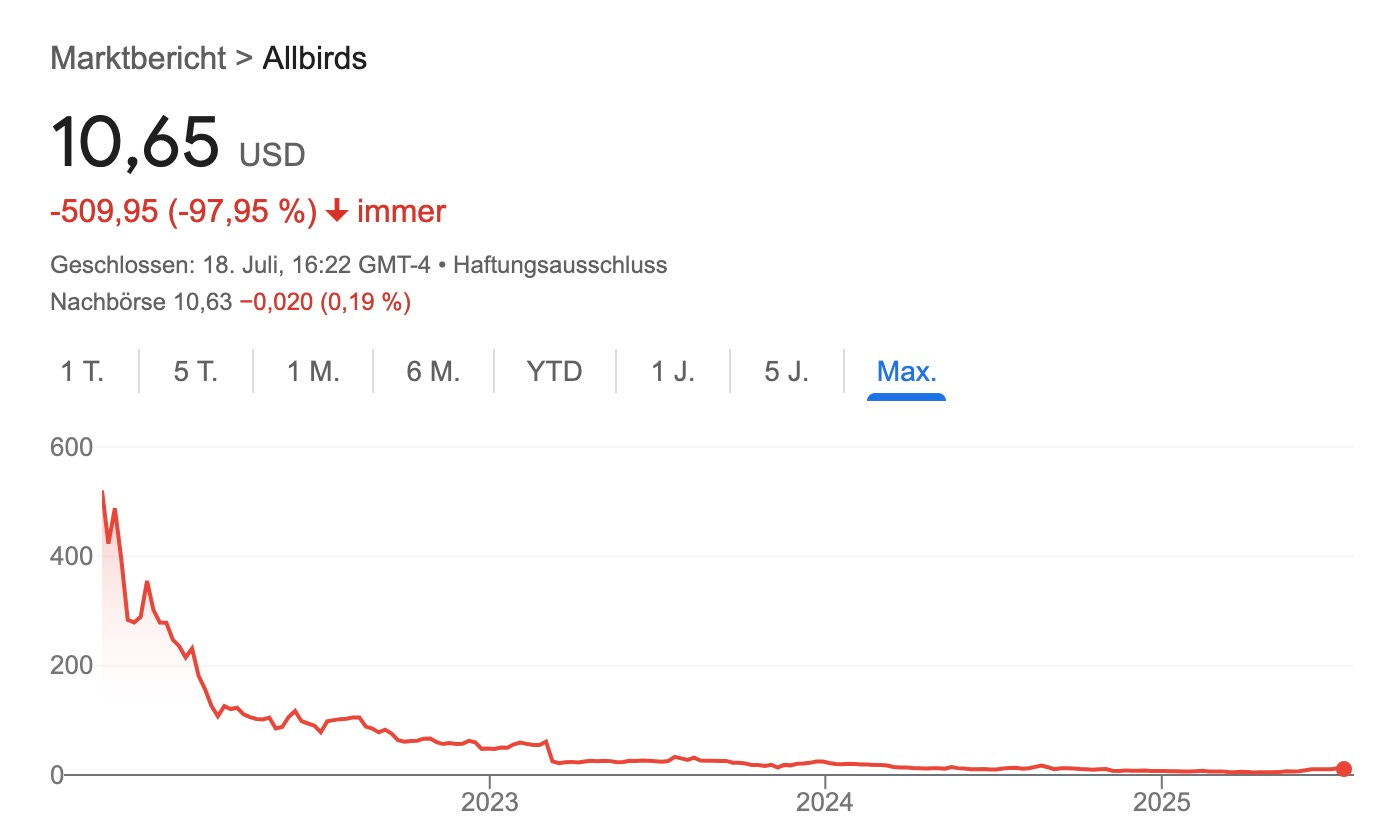
Was the value of Allbirds wrong at IPO? Probably. In the short-run, investors are susceptible to buying narratives. But in the end, it takes two to tango. Understanding what drives human behavior is a truly fascinating endeavor. It has been investigated for millennia and there are many lessons to learn, but most people don’t bother to read and learn (i.e. do the work). As Shakespeare wrote 400 years ago, value is not decided by one man's will, value exists in the object as well as the person who desires it.
But value dwells not in particular will;
It holds his estimate and dignity
As well wherein ’tis precious of itself
As in the Prizer.
Troilus and Cressida Act 2, Scene 2
However, there is another important lesson in the dead parrot sketch. How do you know if the parrot is dead or just resting? You have to do the work. I'm going to repeat myself until you get it.

Last post I mentioned that there may be something wrong with iShares Core MSCI EAFE ETF (IEFA). Not sure if anybody bothered to investigate it so here is a high level critique.
The summary page for IEFA explains that the fund provides exposure to a broad range of companies in Europe, Australia, Asia, and the Far East. This may sound appealing, but when you look at the top holdings it is heavily tilted towards European equities. And there is “consensus” on the street that Europe is a bad investment because the MSCI Europe Index returned only 4.2% over 10 years. The narrative continues that Europe is a collection of low-growth mature economies with negative population growth tinkering on the edge of irrelevance.
The points above may be valid, but the following graph may surprise you. Year-to-date IEFA has returned more than double the S&P500! Not too shabby for old Europe.
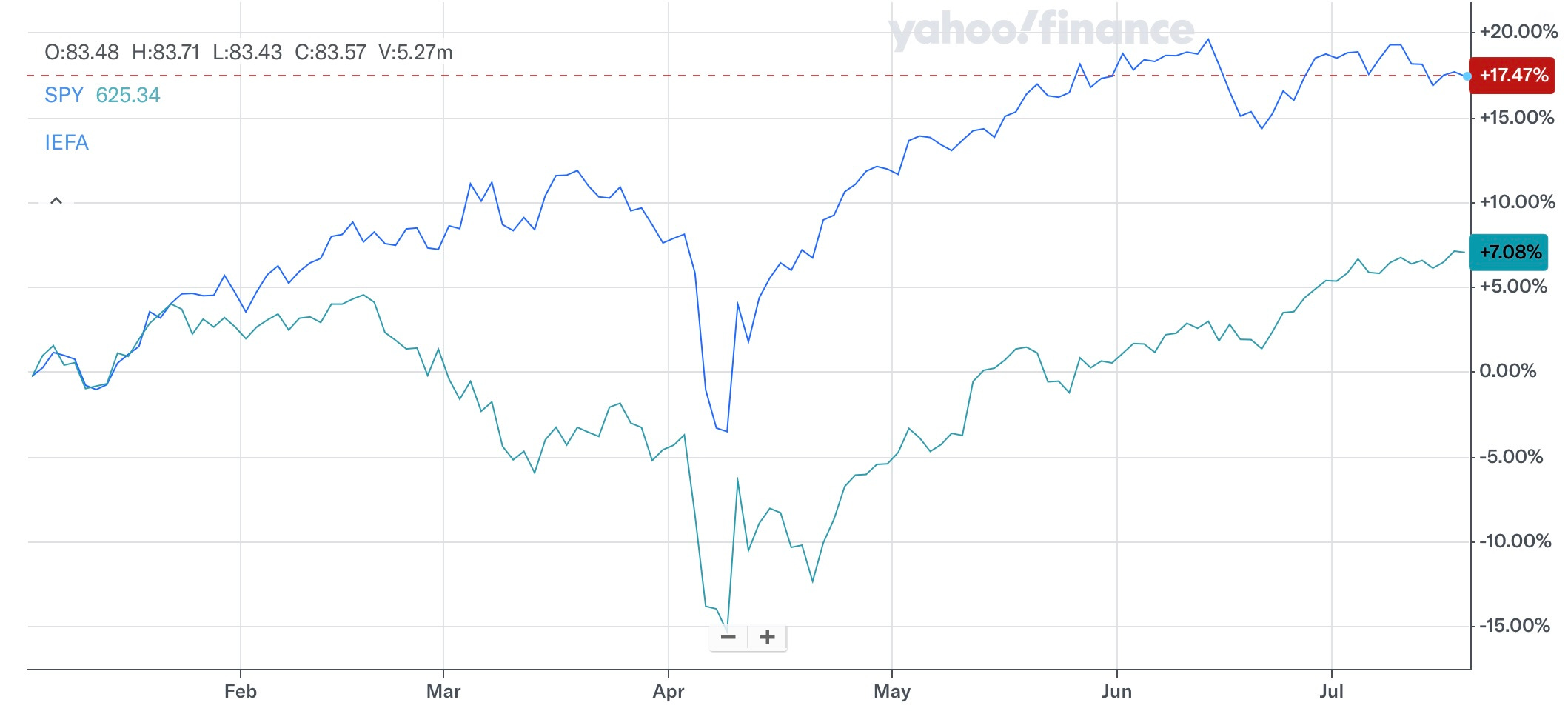
As it turns out IEFA has some well recognized global companies such as SAP, Nestle, Shell, Novo, so it is not a pure European play. Further, it has other well established non-EU corporations such as ASML and Toyota.
So, should you keep all your international allocation on IEFA? Maybe. Would you like some Emerging Markets (EM) exposure? EM is such a basket case that most people shy away from it. Still, the BRICS narrative provided above average returns for many years starting in the 2000s. Conveniently, at the end of iShares page on IEFA you will find the prospectus for IEMG: iShares Core MSCI Emerging Markets ETF.
Didn’t I tell you that Wall Street is the most formidable marketing machine ever?
Note: My personal favorite Python sketch and most absurd.
Philosophy football: Greece x Germany.